Introduction
The Relaxed Lasso package is a Python implementation of the improved version of classical lasso regularization for linear regression, as per the paper Relaxed Lasso by Nicholas Meinshausen (2007), in the style of scikit-learn.
For more information about Relaxed Lasso, see below.
What is relaxed lasso, when is it used ?
Lasso, and its improvement Relaxed Lasso, are extensions of linear regressions. The main benefits are their ability to deal with colinearity, high dimensions (even higher than number of samples) and the fact that they lead to a sparse solutions.
According to Hastie, Tibshirani (2016) in Best Subset, Forward Stepwise, or Lasso, relaxed lasso is the overall winner when it comes to variables selection.
Surprisingly up to now there was no Python implementation of this algorithm, although one exists in R (relaxo).
Relaxed Lasso concept
The current work is motivated by linear prediction for high dimensional data, where the number of predictor variables p is very large, possibly very much larger than the number of observations n. Regularization is clearly of central importance for these high dimensional problems.
The key concept is that there are two regularization parameters, α ∈ [0, ∞) which controls the variables that will be retained in the model, and θ ∈ (0, 1] which acts as a multiplicative factor of α to choose the amount of regularization applied to the subset of variables.
The relaxed Lasso estimator is defined for α ∈ [0, ∞) and θ ∈ (0, 1] as :
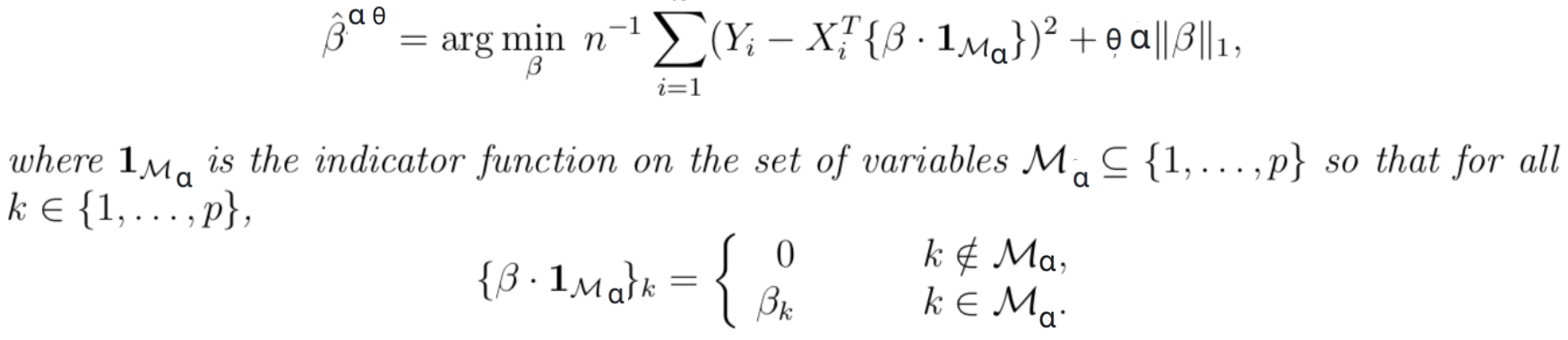
Note that :
- θ = 1 corresponds to standard Lasso.
- θ = 0 corresponds to the Ordinary Least Square solution for the subset of variables selected with α.
Implementation
- The implementation in the class RelaxedLassoLars uses least-angle regression (LARS) as the algorithm to fit the coefficients.
- The implementation in the class RelaxedLasso uses the coordinate descent to fit the coefficients.
Algorithm
The main advantage of the relaxed Lasso estimator over Bridge estimation is the low computational complexity.
Basically, the Relaxed Lasso solution is equivalent to computing 2 steps of Lasso in a row. The first stage being for the variable selection as in ordinary Lasso estimation, and the second one for the shrinkage of coefficients.
It is shown in the paper that for many data sets, the computational effort of computing all relaxed Lasso solutions is identical to that of solving the ordinary Lasso solutions. Because the “direction” in which relaxed Lasso solutions are found is identical to the directions of ordinary Lasso solutions. These directions do not have to be computed again.
Indeed, by extrapolating the path of the ordinary Lasso solutions, all relaxed Lasso solutions can often be found. So we used the refined version of this algorithm instead.

Experiment results
We generated datasets where the number of predictors is much larger than the number of observations as per Wang et al. (2010) in Variable selection via combined penalization for high-dimensional data analysis.
More specifically, the dataset consists of 1000 variables and 50 rows, with high colineraity between columns. The colinerarity between columns respectively with index i and j is defined by the formula \(0.5^{i-j}\). For instance two contiguous columns have a colinearity of value 0.5
The output is a linear combination of only 6 variables, with added gaussian noise of standard deviation 2.
| Variable number | Coefficient value |
|---|---|
| 0 | 7 |
| 10 | 5 |
| 20 | 3 |
| 30 | 1 |
| 40 | 0.5 |
| 50 | 0.2 |
Here are the results of running lasso and relaxed lasso on 100 such datasets:
| Avg. number of variables retained | Avg. Mean Squared Error | |
|---|---|---|
| Lasso | 23.62 | 9.13 |
| Relaxed Lasso | 4.08 | 7.11 |
In such a setting it shows a clear superiority of relaxed lasso which leads to sparser, better fitting model.
Example gallery
An example of the RelaxedLassoLars class :
from relaxed_lasso import RelaxedLassoLars
from sklearn.datasets import make_regression

X, y, true_coefs = make_regression(n_samples=50,
                                   n_features=1000,
                                   n_informative=5,
                                   noise=4.0,
                                   random_state=0,
                                   coef=True)

relasso = RelaxedLassoLars()
relasso.fit(X, y)
relasso.predict(X)
An example of the RelaxedLassoLarsCV class :
from relaxed_lasso import RelaxedLassoLarsCV
from sklearn.datasets import make_regression

X, y, true_coefs = make_regression(n_samples=100,
                                   n_features=1000,
                                   n_informative=5,
                                   noise=4.0,
                                   random_state=0,
                                   coef=True)

relassoCV = RelaxedLassoLarsCV(cv=3) # 5 folds by default
relassoCV.fit(X, y)

print("R-squared: ", relassoCV.score(X, y))

# Best parameters
print("Best Alpha: ", relassoCV.alpha_)
print("Best Theta: ", relassoCV.theta_)
relasso.predict(X)